home I index I latest I glossary I introductions I e-mail I about this site
All Saints, Beeston Regis



Follow these journeys as they happen at Last Of England Twitter.
| All
Saints, Beeston Regis The
setting here must have been an idyllic one before the
mid-20th Century, and it is still a memorable one today.
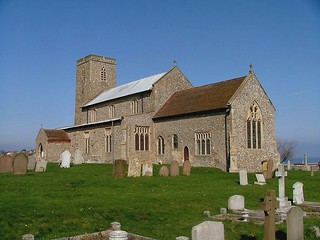
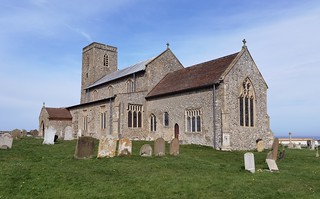
The church sits on a clifftop, or more accurately a
bluff, facing out to the grey North Sea. A track comes
down from the main Cromer to Sheringham road and crosses
a railway line, and then runs alongside a wide meadow to
the church, which still retains a sense of solitude
despite the fact that today it has many near neighbours,
all of them static caravans. The famous Beeston Bump
rises from the landscape beyond them to the west. The sea
is near enough for you to hear it crashing on the
shingle. The unbuttressed tower is an early one, 12th or
perhaps even 11th Century, and square at a time when many
of its Norfolk contemporaries were round. The
clerestoried and aisled nave is typical of many 15th
Century East Anglian rebuildings, but on a smaller scale
than most. The chancel is older, and grand in a different
way, and perhaps its Decorated 14th century lightness
tells us of a complete rebuilding of the church at that
time, apart from the tower, and the nave arcades inside
will confirm this.
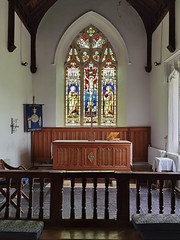
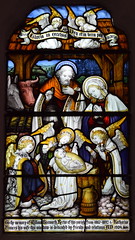
An intriguing puzzle is the pair of corbel heads set either side of the chancel arch. They are only about a metre and a half off of the ground, so perhaps they are too low to have had anything to do with the rood apparatus. However, at neighbouring Upper Sheringham, where the rood loft floor survives, it is supported by two uprights springing from the floor. Could the rood loft here have been supported by two uprights springing from these corbels? Up in the chancel there is a grand sedilia, which Mortlock wondered if it had come from nearby Beeston Priory, but that seems unlikely given that the chancel there was earlier than this one. There are also two good early 16th Century figure brasses for John and Katherine Deynes and a roundel brass of St Luke's winged calf. The late 19th and early 20th century glass is unobtrusive. The east window is an 1894 crucifixion scene by Edward Frampton, which I think must more or less date the completion of the restoration of the church. The best glass in the chancel is an Adoration of Angels by Herbert Bryans of 1904, just when he was setting out on his solo career. Incidentally, I don't like to publicly point out other people's mistakes, because I know how depressing it is when other people publicly point out mine, but Birkin Haward, the great expert in these matters, credits this glass to Kempe & Co. It is true that Bryans had worked for Kempe, and had probably been involved in developing their house style. At this stage of his career he was still heavily influenced by it, although he would soon evolve his own lighter, sparer style. But the glass is actually signed by Bryans, so I think perhaps that Haward should have noticed, especially as his error has not unexpectedly been repeated by others, including the most recent edition of the Buildings of England volumes for Norfolk. Simon Knott, May 2023 Follow these journeys as they happen at Last Of England Twitter.
|
|
|||||||||||||||||||||||||||||||||||||||||||||||||||||||
home I index I latest I introductions I e-mail I about this site I glossary
links I small
print I www.simonknott.co.uk I www.suffolkchurches.co.uk
ruined churches I desktop backgrounds I round tower churches