| |
|
There are islands off the coast of Norwich.
Here we are in typically rural Norfolk, a quiet village
set in a rolling landscape of farms and sprawling fields
punctuated by woods and copses, the sound of traffic on
the busy A11 and A47 not so very far off. And yet, we are
very close to Norwich, but floating free from it thanks
to local authority planning.
Norfolk and Suffolk have their similarities of course.
Norfolk is a lot bigger, and emptier, especially towards
the west. But the biggest difference between the two
counties is their relationship with their county towns.
Ipswich, above all else, is Suffolk distilled and
amplified, the working and historic county translated
into an urban setting. Industrial Ipswich was the
fountainhead of the county's agricultural production, the
docks an interface between Suffolk and the world. To know
brash and breezy Ipswich is to know what Suffolk was and
is.
But Norwich is different to Ipswich, and it is different
to the rest of Norfolk. As you enter the city you pass
hoardings which proudly proclaim, in George Borrow's
words, that you are entering Norwich, a Fine City!
It is like crossing a forcefield. Norwich is a fine city,
and it is also a small city, but as Norwich is so far
from any other place of near-equivalent size - Ipswich is
40 miles away, Cambridge nearly 60 - it is completely out
of scale to its population. If Norwich were dropped into
South or West Yorkshire, or Greater Manchester, it would
disappear. Here, it assumes the importance of a Leeds or
a Sheffield, cities four times as big.
At times, Norwich can feel like a great
European city, living a technicolour life in the soft,
pastel setting of its rural hinterland. Its industrial
past, in shoes, textiles and chocolate, was not grounded
in the local countryside in the same way as the industry
of Ipswich. In the 1960s the University of East Anglia
came, and Norwich's nightlife is lived by people who
have, in fair proportion, not grown up in Norfolk.
To set off from Norwich is to enter a countryside that
feels different. It is like leaving a shore for the open
sea, a sea with islands. The soft fields of Norfolk wash
right up against the edge of the city, insulating
villages that would have been absorbed if she had grown
any larger. Just a mile or so from the edge is Bawburgh.
Every island has a story, and Bawburgh's is the story of
St Walstan.
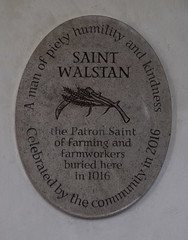
St Walstan was a Prince, the son of Benedict and Blid of
the royal house of East Anglia. Blid would herself become
a Saint. Walstan was born in Bawburgh, or perhaps at the
royal vill of Blythburgh in Suffolk. As a teenager, he
followed Christ's instruction to renounce all he
possessed and become a disciple. Giving up his claims to
succession, he did not delay to reach northern parts,
as the Nova Legenda Anglie tells us, and
humbled himself to become a farmworker in central
Norfolk.
After a series of adventures which revealed his saintly
character, one of which involved him being rewarded with
a pair of young oxen, he received news in about 1015 from
an Angel. He would die and be received into heaven in
three days time. With typical East Anglian stoicism, he
nodded his head and left his scythe to go and find a
Priest to receive the Last Rites. Unfortunately, the
Priest had no water, but, magically, a spring welled up
where they stood.
This was in Taverham, and when Walstan died the two oxen
carried his body on a cart to be buried at Bawburgh. On
the way, they stopped to rest in Costessey, where another
spring sprang up. At last, they came to Bawburgh. They
stopped outside the church, and a third spring appeared,
the biggest. And then, the Nova Legenda Anglie tells
us, Angells opened the walls in hast, and the
two oxen with their burden walked into the church.
Walstan's body was placed in the church, becoming a site
of pilgrimage for people who sought miracles and healing.
Eleven miracles have been handed down to us.
 |
|
The
St Walstan legend is interesting for all sorts of
reasons. Compared with the West Country,
survivals of local Saints' cults are very rare in
East Anglia. This part of Norfolk was strongly
recusant during the penal years, and it is likely
that local people kept stories of Walstan in
their tradition even after the practice of
devotion to him became impossible. When the penal
years ended, the new Catholic church at Costessey
in 1841 was dedicated to Our Lady and St Walstan.
Although there is no evidence that the Saint was
part of the original dedication of Bawburgh
church, the foundations of which certainly
predate the St Walstan legend, it bears the name
today, and that is because the relics of St
Walstan continued to be important right up to the
Reformation. Bequests made to the shrine are
recorded in late Medieval wills, and these in
turn were noted by 18th century antiquarians who
restored dedications to parish churches, not
always very accurately, after the long puritan
night.During the late 14th century, when
acts of pilgrimage were at their most
significant, thousands of people must have made
their way every year. On the north side of the
church was the chapel that contained his bones.
From this, a sunken pathway led down the steep
hill to the well on the site of the third spring.
Incredibly, this pathway was destroyed as
recently as 1999, to be replaced by a sterile
driveway that circumnavigates the farm to the
north of the church.
|
The date of the Walstan legend is
interesting, right on the eve of the Norman settlement of
England. It is almost exactly contemporary with that much
more famous legend, the founding of the shrine at
Walsingham by Lady Richeldis. Could it be that these
cults endured partly as a form of resistance by the
Saxons, popular local legends in the face of Norman
cultural hegemony? Or was it that the Normans themselves
who ensured that these popular pieties continued,
nurturing them in the place of surviving neo-pagan
practices?
We can never know, but what is certain is that St
Walstan's legend recommended him as a Saint of the
ordinary people, a worker Saint if you will, which may
explain his almost complete disappearance from popular
English story after the Reformation.
Two excellent books by local author Carol Twinch have
helped popularise this very East Anglian figure. And,
interestingly, in the latter half of the 20th century his
cult has been explored increasingly by the Anglicans, at
a time when devotion to Saints seems to be going out of
fashion in that Communion. There are popular pilgrimages
here every year still under the auspices of the Anglican
Diocese of Norwich. Perhaps it is the simplicity of
Walstan's life, and the healing nature of his miracles,
that lend themselves particularly to the quiet nature of
modern Anglican spirituality.
You approach the church from the village street and your
first sight of it is from the south-east, looking down
into the churchyard. What a beautiful church it is! It
must be among the loveliest of all East Anglia's 160-odd
round-towered churches. The idiosyncratic stepped gables,
the red roof of the nave and a little flame-like pinnacle
on the cap of the tower are memorable, particularly in
this dramatic setting on the steeply-pitched side of the
ridge. The graveyard falls away dramatically on the
northern side, and from there St Mary and St Walstan
appears fortress-like.
You step into a wide, simple interior, white walls and
bare wood setting into relief sudden flashes of colour.
How much of this church was here when Walstan's body was
brought here? Probably, none of it. The archway to the
tower is 13th century, and the windows suggest that the
rest of the building is early 14th century. Quite
probably, the whole church was rebuilt as a result of the
prosperity brought about by the shrine of St Walstan. On
the north side of the nave there is a large archway, a
filled-in opening. It is tempting to think this is the
wall that the Angells had opened in hast, but it
was probably the entrance to the later chapel of St
Walstan, since this wall post-dates the St Walstan legend
by 300 years.
The remains of the 15th century roodscreen are made up
rather dramatically into an early 20th century screen
with bubbly cusping and a canopy of honour above, all of
it unpainted. It is difficult to know how they resisted
painting it, but it suits the simplicity of the building
just as it is. And there are plenty of survivals here of
Bawburgh's colourful Catholic past. Most interesting of
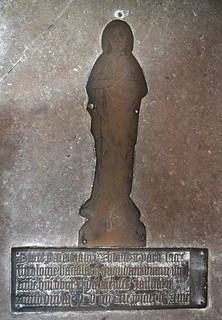
all, the collection of brasses. Bawburgh has two shroud
brasses and a chalice brass. The biggest of these is
above a memorial inscription to Thomas Tyard who died in
1505. It is 60cm long, and he lies with the shroud partly
open, his hands crossed in an act of piety. Beneath it is
the inscription plate, but it seems likely to me that the
inscription and the shrouded figure do not belong
together, given the differences in the quality of the
two. As if to confirm this, a surviving brass rivet in
the stone above the figure's head suggests the loss of
another brass, presumably Tyard's.
The other shroud brass is unidentified, and quite
different. It depicts a smaller figure sewn tightly into
a shroud, with just the face peeking out. It is so like
the figures mounted on the wall at Yoxford in Suffolk
that I assume it is a figure adrift from a larger
collection, perhaps representing one of the dead children
of a larger figure.
Set in between them is a late 17th century brass
inscription and shield to a minister of this church,
Philip Tenison. It is quite fitting that it should be
here, because Tenison was an antiquarian at a time when
such things were looked on with grave suspicion, and
Carol Twinch notes that he recorded information about the
Walstan shrine here that might otherwise have been lost
to us. Deprived of his living by the Puritans, he later
became an Archdeacon after the Restoration, in which case
the date of 1660 here is obviously wrong.
I think that all five of these brasses were reset here
from elsewhere in the church by the Victorians. The
chalice brass may well be in its original position. It is
to the Priest William Rechers, and is right on the eve of
the Reformation, 1531, so he would have been one of the
last Priests to be commemorated in this fashion. As at
Little Walsingham, two hands are shown holding the base
of the chalice, elevating it.
In the nave, there are three further pre-Reformation
brass inscriptions, at least two of which are on their
original matrices, and one of which retains one of the
two figures commemorated, Robert Grote, who died in 1500.
His wife is missing, as is the Priest Edward Kightling,
whose empty matrix shows that he was wearing priestly
vestments.
 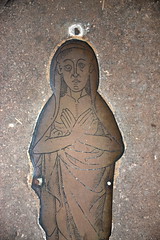 
 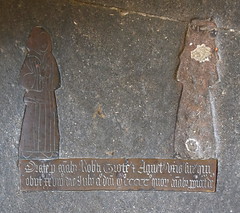
This is a good collection of late medieval
brasses, and is remarkable hat so much has survived. Only
a couple have been stolen, but it is clear an attempt has
been made on the life of the smaller shroud brass. It has
been broken in half, and the lower part protrudes
upwards. These chancel brasses have also suffered very
badly from being covered by carpets, the underlay
breaking up and soaking with moisture to scour the brass.
On my most recent visit, the churchwarden agreed that to
would be better to remove the carpet altogether, and I do
hope that this will happen.
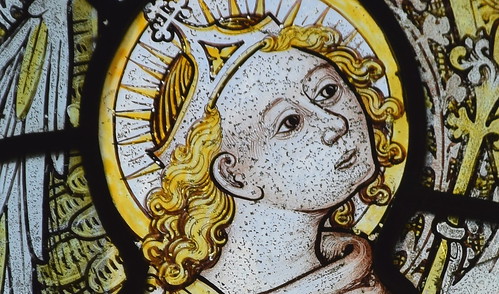
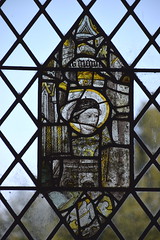
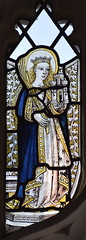
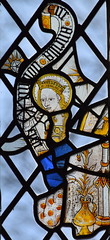
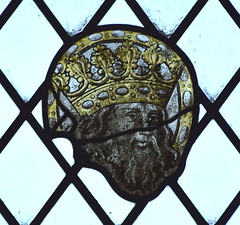
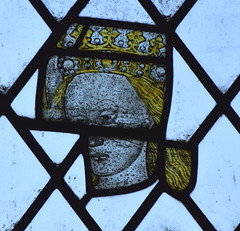
But the most vivid memory of the past at Bawburgh is the
collection of late medieval glass in the nave. Best of
all is St Barbara. She stands proudly, holding her
church. Across the nave is a lovely fragment of an
Annunciation scene. Mary stands in front of a pot of
lilies, and a scroll declares Ecce Ancilla Domini
Fiat ('Behold the Handmaid of the Lord, Let it be
so'). A crowned female head nearby is probably from a
Coronation of the Blessed Virgin.
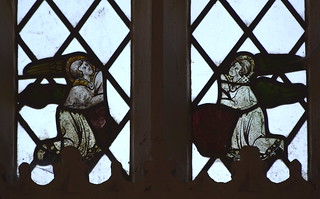
There are floating angels, perhaps censing or collecting
the precious blood at the crucifixion, and a king who may
be Christ from the same Coronation scene. There is
larger, crowned, bearded king, perhaps God the Father,
some fragments of St Catherine and perhaps St Gregory,
and a lay figure in late medieval dress who might just be
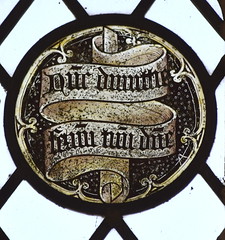
a pilgrim to the Shrine of St Walstan. Perhaps most
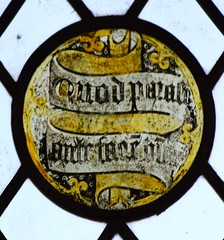
pleasing, because it is so complete, is a set of roundels
featuring the words of the Nunc Dimmitis, Simeon's prayer
on seeing the infant Christ for the first time. It is
rather moving to find them in the same window as the
Annunciation, which features words which would be
familiar to pilgrims from both the Ave Maria and the
Magnificat. It is easy to imagine them sitting telling
their beads at a journey's end, contemplating this glass.
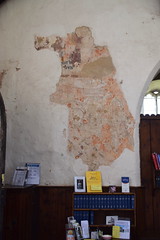
At the west end of the church is a small
patch of wall painting which defies easy interpretation.
It is obviously at least three separate subjects, the
most recent being part of an Elizabethan text, below that
apparently two figures embracing, the lowest a roundel
topped by indecipherable text. It is likely that there is
part of a Seven Works of Mercy sequence, which was often
placed on the western wall of a smaller church like this.
There is much else besides. The people here were
obviously very pleased at the 1660 Restoration, and
immediately erected a new set of royal arms to Charles
II. You can't help thinking of Philip Tenison, and how it
might just be his influence that the people were pleased
to see the back of puritanism. One old bench end with an
inscription is marooned on the wall, curiously in the
shape and location of a holy water stoup (is it covering
it?) and there's a nice European roundel in the chancel,
which I take to be from a series of Stations of the
Cross. Otherwise all is Victorian, or the influence of
Victorians. And then you spot the 17th century poorbox
fashioned like a newel post, still secured in the east
end of the nave. It is from the protestant days of this
church, but it is still a reminder of charity, and the
offerings of generations of pilgrims that made this one
of Norfolk's most significant shrines, and still a
beautiful and interesting church today.
Simon Knott, April 2019
Follow these journeys as they happen at Last Of England
Twitter.
|
|
|