home I index I latest I glossary I introductions I e-mail I about this site
St Peter and St Paul, Barnham Broom


Follow these journeys as they happen at Last Of England Twitter.
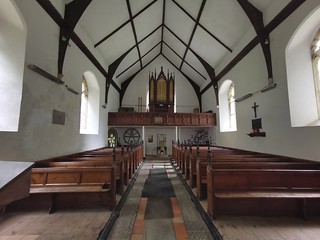
St Peter and St Paul, Barnham Broom Here we are in the rolling landscape to the west of Norwich, the fields and copses around Dereham and Wymondham which form the heart of Norfolk. Occasionally there's a busy road, but mostly it's just little lanes winding and staggering around ancient field patterns or the forgotten boundaries of some long-dead squire's proud acres. Mostly quiet farming country, the occasional hotel or golf course reminds us that we are not far from Norwich, but nowhere, apart from Wymondham and Dereham, is of any size, and the only buildings of any consequence are the churches. Barnham Broom is
perhaps not a place that many will know, but it has a
church of great interest. Although the western extension
to the graveyard is flat and open, the trees encroach
upon and enfold the church itself, and the eastern end of
the graveyard falls away into thick woods that make a
view of the church from this end impossible. The ground
is lush with elder and ivy, and a poignant little child's
grave floats like a buffeted boat among the trees. You
seem to step over a boundary immediately to the east, and
I wondered if this was into the edge of the park of some
great Hall, now lost to us. The structure of St Peter and
St Paul, as with so many big East Anglian churches, is
almost entirely the work of the early 15th Century.
Pevsner records bequests for the tower and bell in 1434
and 1440, so this may be a clue to the finishing date of
the rebuild. Half a millennium later, the 19th Century
restoration was considerable, but the Victorians weren't
the first that century to try to put this building back
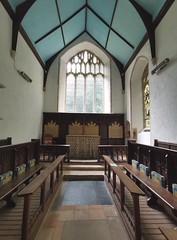
into order, and you step into an interior that is clean,
bright and has a feel of the early 1800s as much as
anything later. This is accentuated by a deep, uncanted
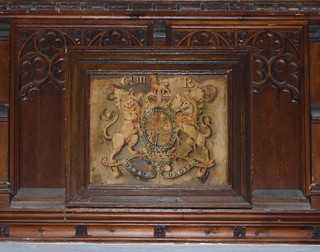
gallery with the arms of George III on the front,
probably a clue to its date.
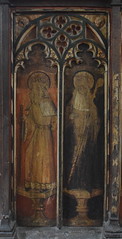
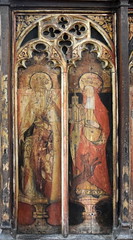
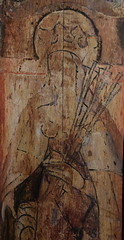
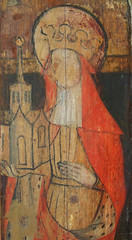
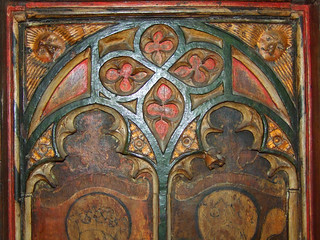
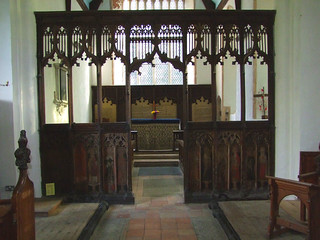
On the north side, the
first two panels are blank. The third has a shadow of a
figure, but if you look carefully you can see that it was
wearing a triple crown, and is therefore St Gregory.
Beside him, St Clement holds an anchor. The last two
figures on this side are St Walstan, who came from nearby
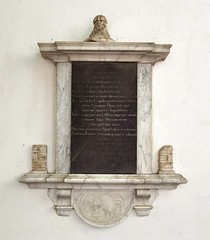
Bawburgh, and an unidentified Bishop. There's a double figure brass in the middle of the nave to John and Ellen Dorant. They died in 1503, and the unvandalised inscription asks for prayers for their souls, a request that would stand for barely forty years before it stopped being met. A couple of centuries later, the memorial to Rector Nicholas Canning and his son on the chancel wall appears incomplete, but the little stacks of books on each wing are rather sweet. The laurelled skull at the bottom is grinning, as if it knows something that we don't, which is probably right. Incumbents here in the 19th Century included members of the Gurdon family of Letton Hall and the Wodehouse family of Kimberley Hall, who presented to the living. The rector received £540 a year, roughly £130,000 in today's money, although he also had to do duty as the vicar of nearby Kimberley. The Census of Religious Worship of 1851 mentioned that this income was exclusive of Plantation, Pleasure Ground, Garden etc, and with barely ten per cent of the parish population attending morning service on the day of the census you can't help thinking there were worse jobs to have. Simon Knott, December 2021 Follow these journeys as they happen at Last Of England Twitter. |


|
|||||||||||||||||||||||||||||||||||||||||||||||||||||||
|
|||||||||||||||||||||||||||||||||||||||||||||||||||||||
home I index I latest I introductions I e-mail I about
this site I glossary
Norwich I ruined churches I desktop backgrounds I round tower churches
links I small
print I www.simonknott.co.uk I www.suffolkchurches.co.uk