home I index I latest I glossary I introductions I e-mail I about this site
St Mary, Baconsthorpe


Follow these journeys as they happen at Last Of England Twitter.
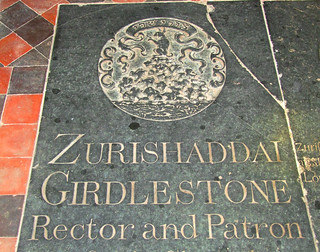
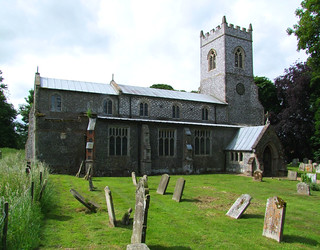
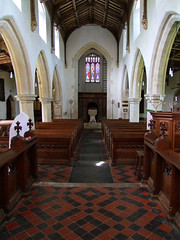
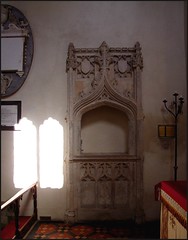
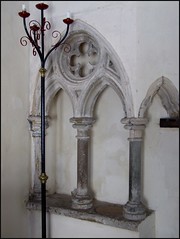
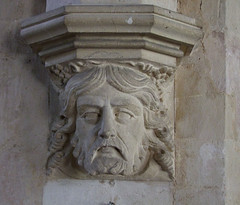
St Mary, Baconsthorpe This big church seems out of scale for the narrow lanes around here, as if it were some great ship marooned up a backwater. Beached now in a faithless age, it broods silently in a graveyard cropped by sheep. St Mary is essentially a Decorated building, with an older chancel, an unusual juxtaposition in East Anglia. Late-medieval prosperity would bring nothing more than new window tracery. The tower was rebuilt in the 18th Century, but very much in the Gothick style. Mortlock thought it restrained yet elegant. There is nothing so old as the recent past, and the Victorian restoration here gives the interior a wistful feel, of a time now out of sight. There are so many crisp little churches in this part of Norfolk, but to come here is to sense a building which has relaxed into a still, calm decay, a slightly ramshackle feeling, which is attractive, but rather sad nonetheless. Like many lonely places, St Mary has its curiosities. A large, bearded corbel head supports the arcade on the south side. Nearby is a wall painting of a cockerel with the words Laudes Deo, which may have been associated with a vanished tomb here. There is a beautiful Easter sepulchre with a double piscina opposite. Between the two are some curious ledger stones, remembering three Baconsthorpe worthies of the 18th century, all of them, surprisingly perhaps, called Zurishaddai Girdlestone. Their ledgers depict a boxing hare, with the inscription in Hebrew meaning 'the Almighty is my Rock'.
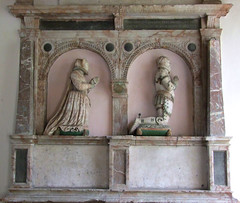
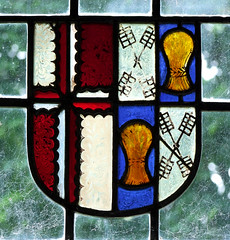
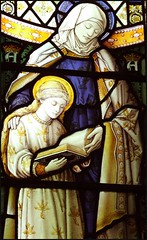
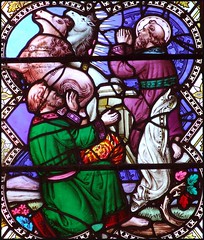
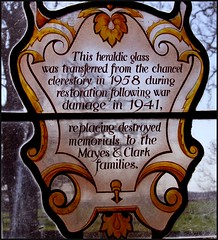
The Girdlestones had lived at Kelling Hall, to the north of here. One of them had been particularly well-known. In 1860, a Colonel Hamilton recalled visiting the old gentleman some fifty years before, in his memoir 'Reminiscences of an Old Sportsman'. He went to stay with Girdlestone at Kelling, and records that: I was not a little surprised to see him with a single-barrelled gun, apparently the size of a soldier's firelock of that period, and a barrel at least a foot longer than those of my own gun, the bore as large as one for shooting wild fowl. The stock had been made by a London gunmaker, and the lock, which was particularly well finished, by the same. Mr. Girdlestone told me that the barrel came from Berlin. In the first field we came to the dogs pointed, a strong covey rose, I shot a bird, but my companion did not fire; he said the birds were too near. Shortly after, a single bird rose at about thirty yards; I fired both barrels and missed. Then the old squire coolly put up the great gun to his shoulder, and brought the bird down as dead as a stone. The distance from where we stood to where it fell must have been at least seventy yards. He gave me a triumphant look and said, 'This is my system of partridge shooting.' Mr. Girdlestone had been brought up to the bar, was an active magistrate, but was considered an eccentric character, living in a very retired way. The magisterial room of my friend might be considered as the model of a sportsman's apartment. On the walls were wooden racks containing single and double-barrelled guns, in other parts, rods for trolling and fly-fishing, with all their appendages; in the corners of the room, landing nets, a small casting net, and fishing krails. On a table might be seen a stuffed martin cat and a variety of foreign birds. The Squire's library was not large, but displayed his predominant passion for field sports, with some law books and works on agriculture. This sanctum sanctorum looked into a small but well-arranged flower garden. The heraldic glass in the south aisle was reset there, and some of it replaced, after a German bomb destroyed the rectory and blew out the church windows in 1941. What appears to be a parclose screen shelters the organ in the north aisle. In fact, it is the former rood screen brought here from the tiny church at Bessingham, a few miles off. Its Perpendicular confidence strikes a slightly abrasive note in this more ancient space. Dominating the south aisle is the monument to Sir William Heydon and his wife. They kneel stiffly beneath arcades, facing the sunshine, in the proper attitude of late Elizabethan piety. There are no children to mourn for them. The memorial seems out of scale, and Mortlock suggests that it was ordered from a London workshop and was then squeezed into the space here on arrival by sea. This late 16th Century piety is matched in the chancel by that of the early 20th Century, with Shrigley & Hunt's insipid window of St Anne teaching the Blessed Virgin to read, and then the little girl grown up and holding her own child, probably installed here during the First World War. The other stained glass is no more exciting. The west window depicting Moses, the Good Shepherd and Elijah is the 1860s work of the Norwich workshop J&J King, and William Wailes east window of the Resurrection, Crucifixion and Ascension is roughly contemporary with it. But these are minor distractions, for the church is big enough to be filled with white light from the nave windows, and the coloured glass seems jewel-like, not dominating, but offset by stillness and silence, which is as it should be. Simon Knott, November 2020 Follow these journeys as they happen at Last Of England Twitter. |








|
|||||||||||||||||||||||||||||||||||||||||||||||||||||||
|
|||||||||||||||||||||||||||||||||||||||||||||||||||||||
home I index I latest I introductions I e-mail I about
this site I glossary
Norwich I ruined churches I desktop backgrounds I round tower churches
links I small
print I www.simonknott.co.uk I www.suffolkchurches.co.uk