| |
|
St
Michael, Aslacton It has been observed that the area south of
Norwich has the densest concentration of medieval
churches in northern Europe. And yet, some are not so
easy to track down. Aslacton is lost in a maze of
tree-shrouded narrow lanes. You find it where four of
them meet. The church sits at a crossroads less than a
mile from Great Moulton church, which interestingly is
also dedicated to St Michael.
Aslacton is an attractive village, and St Michael is an
attractive, welcoming church, as befits one of the
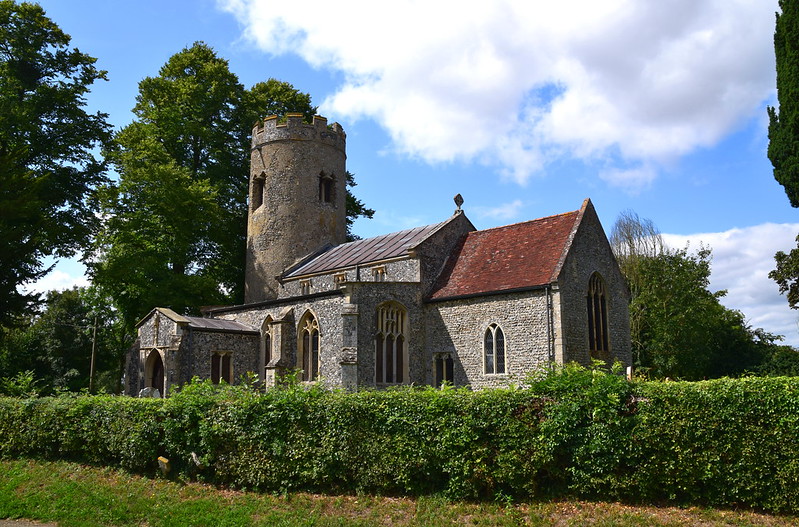
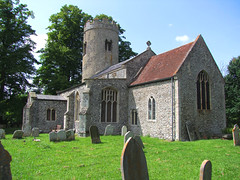
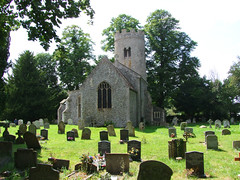
Pilgrim Group of parishes. The most striking thing about
it is the unequivocally 11th Century tower, the
double-headed triangular bell openings telling us that
everything apart from the battlements was here either
before or not long after the Normans arrived and got us
all organised. The body of the church is a history of
what happened subsequently. The nave, probably Norman,
was supplemented by an Early English chancel which
exhibits signs of the Decorated period. Most likely,
given that this is Norfolk, the chancel was built in the
Decorated period with idioms surviving from the earlier
period. And then the 15th Century, which had put the
battlements on the tower, also brought the gorgeous south
aisle, clerestory and porch, completely changing the
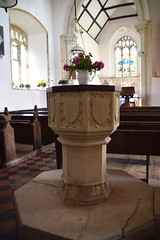
shape of the church. Although there is only an aisle on
one side, the nave is short enough for the interior to
feel square, the big windows of the aisle filling it with
creamy light. It must have been a very narrow church
indeed before the aisle was built, and it is so small
that the clerestory appears that of a toy church.
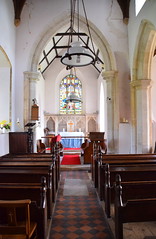
As so often with a church like this, where you enter it
and step into the aisle of a small building, the interior
appears to unfold before you. St Michael is not a
treasure house, but it is a delightful country church
with character and a sense of being at the heart of its
community, a church of ordinary, local people.
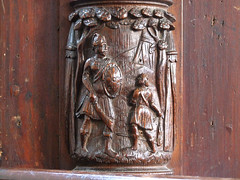
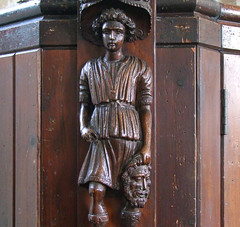
The pulpit is just a simple box built into the north-east
corner of the nave, but adorning its south-western corner
is an elaborate relief depicting David holding Goliath's
head above an action shot of their battle. It looks as if
it may have come from a continental organ case. There are
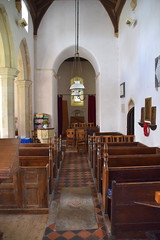
a couple of other curiosities. The arcade that divides
the aisle from the nave does not line up with the chancel
arch, but ends about 60cm short. In between is an alcove.
I think it may have contained the rood loft stair, but it
is hard to see exactly what happened. Was the arcade
begun from the west, while someone was working quite
independently on the rood apparatus at the other end of
the nave? Or, could there have been an earlier attempt to
build an arcade that the Black Death interrupted?
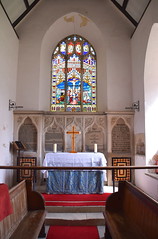
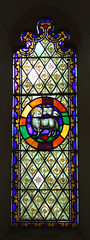
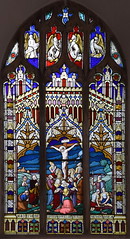
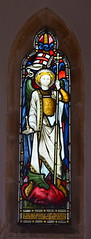
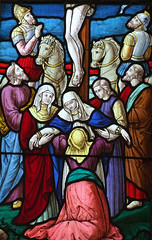
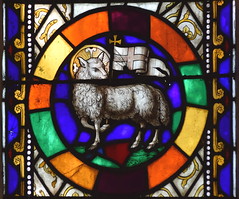
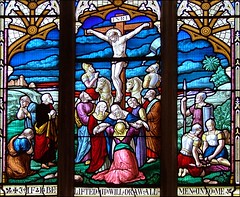
There are bits of 19th Century glass, the Lamb of God in
the west window, St Michael in the chancel, and a busy,
interesting Crucifixion by J & J King of Norwich in
the east window. But this is not a church you'd come to
wanting to see something in particular. Rather, to
experience the sense of an English country church doing
what it has done for centuries.
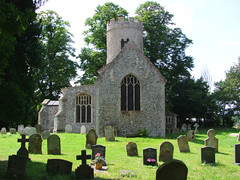
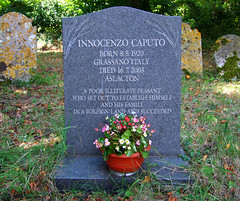
Innocenzo Caputo obviously loved Aslacton. He was a
poor illiterate peasant, who set out to establish himself
and his family in a foreign land, and succeeded. He
died in July 2003, and is buried in the churchyard by the
porch.
Simon Knott, August 2018
|
|
|