home I index I introductions I e-mail I about this site
St Nicholas, Ashill
Follow these journeys as they happen at Last Of England Twitter.
| St
Nicholas, Ashill Ashill is a
busy village to the north of Watton. We came back here in
July 2022, a week after the hottest day ever recorded. A
field fire had spread into the centre of the village,
destroying a dozen houses by the village green. No one
was killed, but passing them was to see an unfamiliar
sight in East Anglia, both raw and shocking. It looked
like a war zone. We travelled on in silence to the
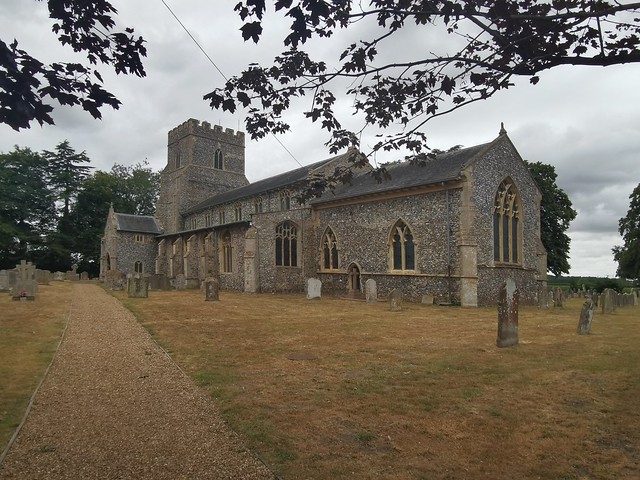
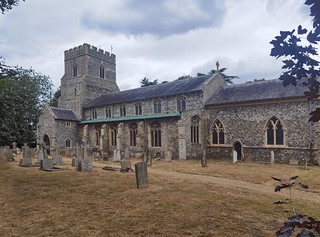
sprawling parish church, which sits in a fairly narrow
churchyard at a wide curve in the road to Watton. At
first sight it seems a typical Norfolk mix of the 14th
and 15th Centuries, but there was a considerable
restoration here, and Pevsner thought that all of the
window tracery was restored, which is to say it is of the
19th Century and tells us nothing about the building of
the church. The tower is substantial but in proportion
not a tall one, and so the overall effect is perhaps of a
crisp building which squats comfortably, and which will
seem larger inside than without. There's an elegant
ogee-arched doorway to the west, familiar from nearby
Carbrooke and Caston. The later two-storey south porch is
a somewhat austere affair, tucked awkwardly into the west
end of the south aisle. The aisle itself, and the
clerestory, are not imposing.
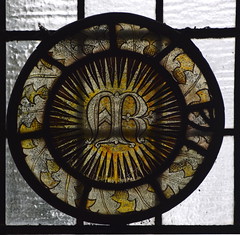
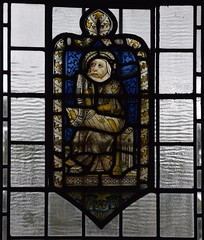
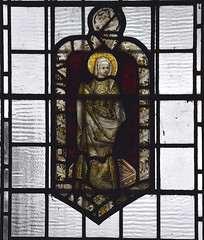
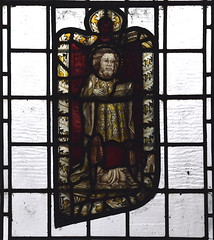
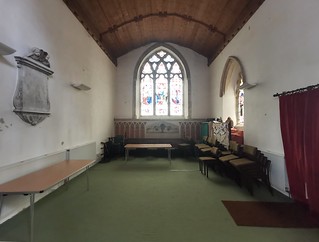
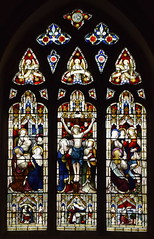
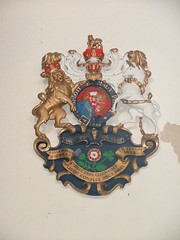
The other glass in the church dates from the 1880s and later. Birkin Haward thought it was all by Lavers, Barraud and Westlake. When I first came here about twenty years ago there was a heavy curtain dividing off the chancel from the nave. This has now gone, and instead the mostly 19th Century rood screen has been fitted with sliding doors, which must be unique in East Anglia. Beyond, the chancel is now in use as a social space. The arcading either side of the east window appears to be 14th Century, as is the font at the other end of the church, perhaps part of the same campaign. A bearded head looks out from under one of the panels of the bowl. The royal arms appear to be painted carved wood or even cast iron, and are charged with the early 19th Century arms of George III. However, underneath a banner inscription reads tollemalos sacrane extolle pios cognosce legem consol disce mori te ipsum 1683, which means something like 'sanctify yourself, extol the pious, know the law, comfort yourself and learn how to die'. The date is odd as it appears to have no connection with the arms, but there is no other indication of its significance, and I don't see how the arms could have been altered or added to an earlier setting. At the west end of the aisle is a Flanders cross, which originally stood above the grave of Machine Gun Officer Lieutenant KC Ford, who died of wounds received in Plogstrat Wood in December 1915. The cross would have been placed above his temporary grave while the battle continued around him - indeed, there is a large hole in the cross caused by shrapnel or a bullet. After the war, the bodies were exhumed and reburied in cemeteries under marble crosses. Often, the original wooden battlefield crosses were sent back to the dead soldiers' families, who usually passed them on to the parish church, and one survives here today. Simon Knott, October 2022 Follow these journeys as they happen at Last Of England Twitter.
|
|
|||||||||||||||||||||||||||||||||||||||||||||||||||||||
home I index I latest I introductions I e-mail I about
this site I glossary
Norwich I ruined churches I desktop backgrounds I round tower churches
links I small
print I www.simonknott.co.uk I www.suffolkchurches.co.uk