| |
|
All
Saints, Alburgh It was one of those intensely hot days at
the start of August 2018, and the cool shade of the
over-bowering trees along the narrow lanes was a
blessing. You don't have to get far from the Waveney and
the busy A137 taking the traffic through to Lowestoft and
Great Yarmouth to find peace. Here in the folding ridges
to the north are secret villages linked by lonely,
jinking roads. I had just come from Denton, its church
hidden in the trees in a dip and reached only by a bridge
and a track through the grounds of the Hall. And now it
was a short distance from there to the larger village of
Alburgh, and I caught my first sight of the curiously
narrow top of Alburgh church tower appearing above the
trees and the barley-stubbled rises. Soon, I came down
into civilisation, and there was the church, its tower
towards the road.
Not a spectacular church at all, but it has a special
connection for me as someone I was very fond of came from
here. I was back after twelve years away, but that visit
was still clear in my mind, not least because of what I
had felt about it then. When I'd got home, I had written:
'Coming down Norfolk by a different road, I came out into
a landscape that I knew. It was early spring, and five
years before I had explored the Suffolk side of the
Waveney valley at the same time of year. Here in Norfolk
were the same rolling, secretive meadows, the copses that
seeped and spread between the fields, the quiet,
scattered parishes with mere hints of village centres.
Introspective hamlets, not talking to each other, the
narrow lanes that connected them veering and dipping as
if trying to shake them off.
At a crossroads, an old Methodist chapel sulked under the
indignity of conversion. And there were wide pig farms
and ancient silage heaps and faded bottle banks outside
the village hall. No commuters here, no holiday cottages
or weekend homes. Everyone except me was here because
they had to be. This was where they lived, where they
worked. They were the modern equivalents of the
blacksmith, the carter, the wheelwright. The Waveney
valley is the heart of rural East Anglia, perhaps the
last truly insular place in the south-east of England. I
was glad to be here.
Alburgh is not a place I have ever thought of often. But
now, in the crisp air, I stood in the graveyard and
looked across the country at the scattered village and
its setting. Beyond the houses was the ancient field
pattern, the beech trees on the ridge and the rooks
wheeling above them. I thought of a song of the early
eighties, Pete Wylie's Story of the Blues, and
his declaiming, towards the end, the words of Kerouac's
Sal Paradise: the city intellectuals of the world are
divorced from the folk-body blood of the land, and are
just rootless fools. I had been born in a place like
this, tiny and remote in the Cambridgeshire fens, a world
away from now in the 1960s. But we moved to Cambridge
when I was two, and I had lived in urban areas ever
since. I was a city intellectual, and I stood now and
looked around at the land, a rootless fool.
I first heard of Alburgh more than twenty years ago. I
was living unhappily in Brighton at the time, learning to
teach, finding out how little I actually knew about
anything. I would cycle out to the University through the
stinking traffic on the Lewes road, and often arrive
cold, wet and battered by the wind from the downs. At
first, I knew nobody, and I spent most evenings in my
attic room listening to music and feeling sorry for
myself. In the bittersweet autumn sunshine of the
weekends I would cycle around the downs, searching for
old churches, repopulating the hamlets and lanes of East
Sussex with characters from Hardy and Trollope.
I hardly
went into town at all. Everybody seems to love Brighton,
and they can't understand it when I say that I don't, but
perhaps I was too often miserable there. In my memory I
still associate Brighton with debt, and with the
transience of being a student. And then, extraordinarily,
a brief, doomed relationship, a love affair, became the
one vivid thing, a brief, sweet memory of my year in that
brash town.
She came from Alburgh, and at first I thought she meant
Aldeburgh in Suffolk, and she said it again, Ar-brer,
and showed me on a map. How narrow was the single bed we
shared, how intense those brief few weeks. And she loved
me more than I could possibly have loved her, for I had
already met the woman who would become my wife. And so it
was messy, and then it ended. But Alburgh still existed,
of course, and so coming here I remembered.
If that had been all there was, then I wouldn't have
thought it worth mentioning, but there was also the
Kerouac quote, and I had recently gone back to the
village where I was born. It was a tiny hamlet, off of
the Cambridge to Ely road. My mother had been born there,
my parents married in the Church there. I was baptised
there, and so were my brothers.
At one time there had been three farms, a shop, a railway
halt, a pub, a school, a church and a chapel. I'm not
looking this up in some mid-19th century White's
Directory, I remember them from the 1960s and
1970s. Now, they were nearly all gone. The farms had been
built over, the pub, shop and chapel converted to houses.
To stand beside the railway line, you'd need a vivid
imagination to guess that the halt had even existed, as
the expresses screamed through at over a hundred miles an
hour.
The church and the school survived, but only because this
was now a commuter village. Every morning, hundreds and
hundreds of white-collar workers left their identical
modern houses and piled up the A10 to Cambridge and Ely.
I knew nobody there any more - my grandmother was dead,
and all my relatives had left, or were lying under the
frozen turf of the little cemetery. It made me sad. I
thought that perhaps this was what growing old was,
seeing change and resenting it. And so I liked Alburgh
because it appeased my sense of loss, as if something
might survive after all.'
All this then, gentle reader, was in my mind as I
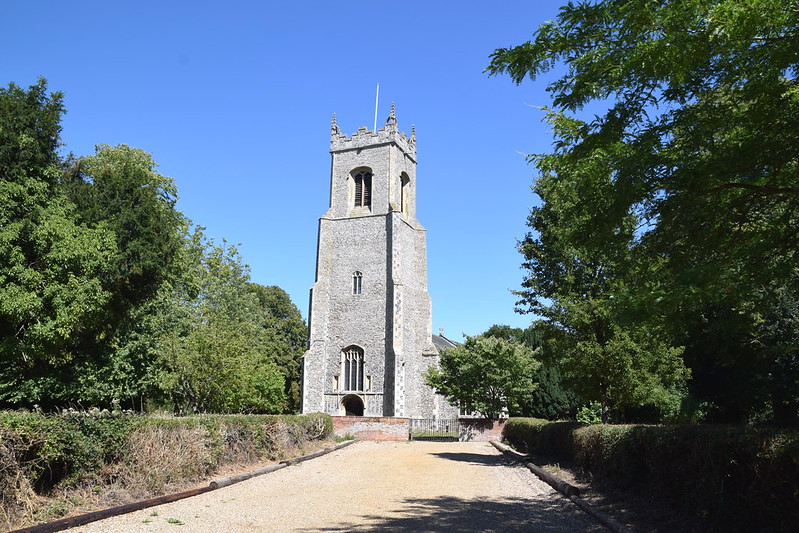
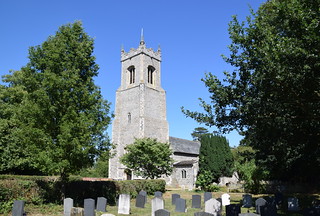
returned to Alburgh after twelve years away. The tower I
had seen from Denton churchyard, and which bobbed its
head above the copses and the rolling fields as I
approached it, stands tall and proud, four-square to the
road, the aisleless nave and chancel disappearing into
the narrowing churchyard beyond. An imposing sight,
though not a huge tower, merely large in proportion. The
bulk of it is probably 14th century, but the bell stage
with its enormous bell windows is later, a late medieval
addition. It looks awkward, because the new building
technology no longer required that the buttresses should
continue up the bell stage. But the effect is
unfortunate, I think, like the unnaturally small head of
a large man. The buttressed pinnacles on the four corners
are a more recent confection, for the very top of the
tower collapsed in 1895, and what we see at the top now
dates from the dawn of the new century.
The west front must have been rather grand once, with
large niches flanking the window, but the canopies of the
niches have gone, either vandalised by protestants or
more likely worn away by the passing of the centuries. In
proportion with the nave, the south porch seems bigger
than it is. A 1463 bequest for the porch by the Wright
family is recorded, but it now looks all of its Victorian
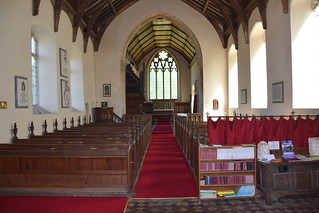
restoration. And so, I am afraid, does the inside of the
church, a big 19th century barn with a lot of the
anonymity you'd expect of this date. And yet, there are
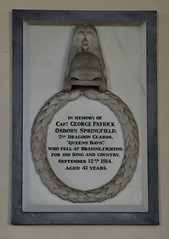
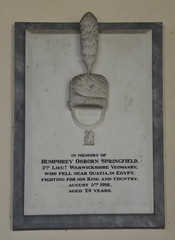
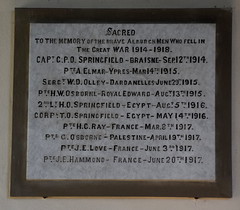
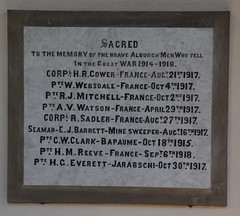
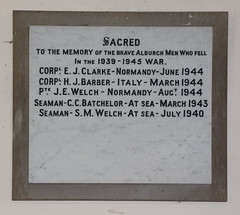
neat, local, rustic touches, and the pride of the early
20th Century parish in the boys who went off to war and
never came back is still evident, great lists of names
rather haunting in their context. Surprisingly, the roof
is old, and it spreads impressively across the wide nave.
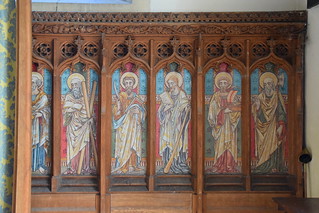
A beautiful gilded rood screen dado is almost defiant in
the face of all the restoration. There are pretty little
gilded gesso saints in niches on the buttresses along the
front, but I think the colour is wholly modern.
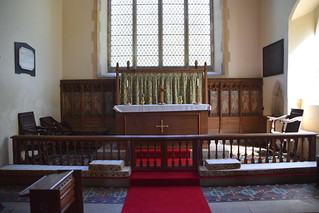
Echoing it, perhaps inspired by it, insipid apostles
flank the altar and its simple reredos, a William
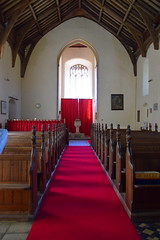
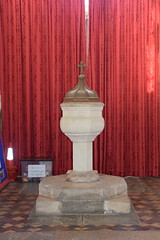
Morris-style hanging. Turning back, the tower arch lifts
tall and dreamily, light from the west window flooding
the reset font below, the space becoming an echo of the
wide chancel arch at the other end of the great roof.
There's a pleasing harmony to the whole piece, and
perhaps the Victorians should not be blamed for too much.
And so, that was all, my return to Alburgh. Just another
church, and yet, like all medieval parish churches, a
place full of stories, and memories, hopes, fears,
regrets, embarrassments, delights, hungers, desires,
agonies, beginnings and endings. Here, I sensed around me
a building that was a touchstone down the long
generations, and a beacon across miles and oceans. Just
another church, but always and everywhere and forever.
Think of the millions of people who can trace atoms of
their being back to this place! Think of the lives
touched by people who stepped out from this parish! And
that's true of anywhere of course.
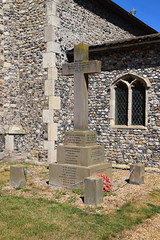
I went back outside and pottered around the graveyard.
The heat was stifling after the coolness inside the
church. A large dragonfly buzzed around my head and then
veered away on the currents rising from the long grass. I
sat down on a bench facing towards the newer headstones,
and placed on the arm of the bench I found to my surprise
a painted flintstone. It had a message painted and
lacquered onto it. On one side was a pink heart, and the
words 'I heart Norfolk'. On the
other side, the artist had painstakingly lettered in tiny
writing 'congratulations on finding a Norfolk Rock', and
asked the finder to 'either take me or rehide me'. It was
extraordinary.
I slipped it into my pocket, not sure if this counted as
taking it or rehiding it, possibly both, and thinking to
myself that it felt like the goal of a pilgrimage. I
wandered over to take a look at the more recent graves,
which included a number in the last twenty years with her
surname on. It is a common one in this village, but I
wondered if any of them could have been her parents, who
I had not known. I thought that she had probably been
married in this place, if she had ever married, and so I
said a silent prayer for all the people I have ever known
and lost touch with, wherever they may be in the world,
whether or not they remember me, or think of me, or are
even reading this now. I stood for a while, thinking of
the years, and then got back in the saddle, shaking off a
maudlin veil which was beginning to settle over me. I
kicked off into a rush of heat lifted by the sudden
breeze of my movement. A long stretch lay ahead of me now
through delicious rolling back lanes with melting tarmac,
zigzagging down into Harleston.
Simon Knott, October 2018
|
|
|